Advanced Interdisciplinary Energy Research Center Foundation

On the morning of November 21, the launch ceremony of the Advanced Energy Interdisciplinary Research Center (hereinafter referred to as the “Center”) of the Global College, Shanghai Jiao Tong University, was held in the Zhongji Lecture Hall of Longbin Building. Present at the event were Hesheng Wang, Dean of the Global College, Mo-Yuen Chow, Head of the Center, as well as faculty members Songliang Chen, Yuljae Cho, Yunlong Guo, Yulian He, Li Jin, Chengbin Ma, Dezhi Zhou, and others. The ceremony was hosted by faculty member Li Jin.

In his opening speech, Hesheng Wang stated that the College will establish a series of interdisciplinary research centers, and the establishment of such centers is an important strategic initiative to promote high-level scientific research development. The Center will actively foster collaboration and exchange among various research teams within the College, forming a synergistic innovation force that will provide strong support to the existing independent Principal Investigator (PI) research model. Based on the actual operation of the Center, the College will provide ample support in terms of student recruitment quotas, laboratory space, and startup funding.
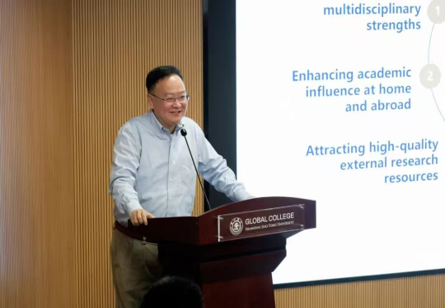
Mo-Yuen Chow provided a detailed introduction to the Center’s mission, vision, and future plans. The Center will leverage the College’s dual advantages of internationalized education and interdisciplinary integration, strongly encourage academic innovation, and support the growth of young faculty and students. In the future, the Center will regularly organize academic exchange activities, gather high-level academic resources, actively promote international research collaboration and industry-academia partnerships, and strive to build an academic hub with global influence.

Subsequently, several faculty members and research group representatives from the College introduced the core research directions of their respective teams. The poster session was lively, with each team showcasing their latest research findings. Faculty and students engaged in enthusiastic discussions, actively exploring potential collaboration opportunities.

Physics-Based Circuit Model

Circuit modeling provides an efficient way to analyze early-stage faults in lithium-ion batteries by simulating key aging processes with a balance of detail and speed. Our research develops a coupled circuit model that captures two critical early degradation mechanisms: SEI growth via a 1RC equivalent circuit and metal dendrite growth via a transmission line circuit model.

By formulating both processes as functions of key electrochemical parameters, the model reproduces their distinct electrical effects on terminal voltage. Parameters are calibrated with a genetic algorithm and validated against experimental data, showing close alignment between simulation and measurement. This offers a computationally efficient basis for early fault prediction and future online diagnostics.

Publications:

[1] Ziqi Wang and Mo-Yuen Chow, “Battery Modeling of SEI and Metal Dendrite Growth: A Transmission Line Circuit Framework with Genetic Algorithm-Identified Parameters ,” 2025 IEEE 20th Conference on Industrial Electronics and Applications (ICIEA), Yantai, China, 2025, pp. 1-6, doi: 10.1109/ICIEA65512.2025.11149030.

[2] Ziqi Wang, Mo-Yuen Chow, Zhiping Tan and Huiqin Jin, “Modelling of the Solid Electrolyte Interface Growth Using Physics-Based Equivalent Circuit Model,” 2025 IEEE International Conference on Industrial Technology (ICIT), Wuhan, China, 2025, pp. 1-6, doi: 10.1109/ICIT63637.2025.10965250.

Electrochemical Model

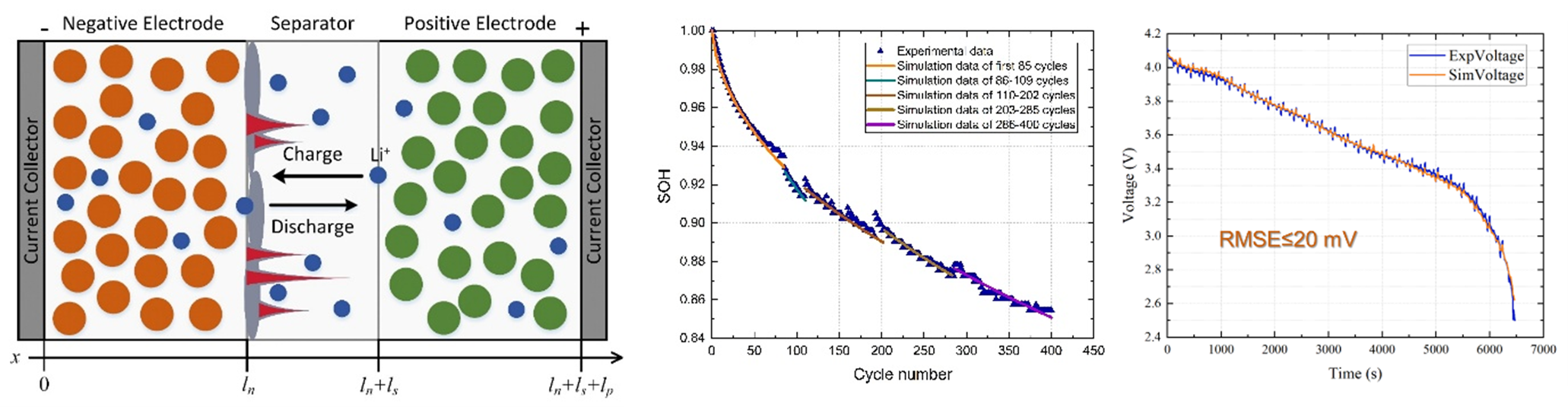
Electrochemical modeling is a key approach for detecting and diagnosing incipient faults in lithium-ion batteries. Despite its computational cost, the pseudo-two-dimensional (P2D) model enables high-fidelity multi-physics simulations and explicitly captures early degradation mechanisms such as solid electrolyte interphase (SEI) growth and metal dendrite formation, thereby providing a physics-based foundation for accurate state-of-health (SOH) estimation and incipient fault analysis.

In this work, a coupled SEI growth and metal dendrite growth model is developed based on the P2D framework and implemented in COMSOL Multiphysics. By incorporating both side reactions into the total volumetric current density, the model captures their coupled effects on overpotential, terminal voltage, and capacity degradation under incipient fault conditions. The SEI submodel is validated using public NMC battery SOH data, showing high accuracy across different aging stages. Parameters of the extended coupled model are further calibrated using a particle swarm optimization (PSO) algorithm and validated under dynamic load conditions, confirming the capability to reproduce battery degradation behavior.

Battery Agent

Battery energy storage systems are increasingly required to respond to fast-changing power demands in microgrids. However, conventional control strategies treat batteries as ideal power actuators, neglecting internal electrochemical constraints and degradation processes. This disconnect accelerates aging, increases fault risk and limits long-term system reliability.

At ADAC lab, we develop a Battery Agent framework to bridge system-level power coordination and battery-internal dynamics. The framework adopts a current-centric control interface, integrating an intelligence layer based on predictive optimization with a physically constrained battery dynamics layer. By incorporating three-electrode battery models, health-related variables such as negative electrode potential and SEI side reaction are explicitly considered, enabling safe, adaptive, and degradation-aware battery operation across multiple application scenarios.