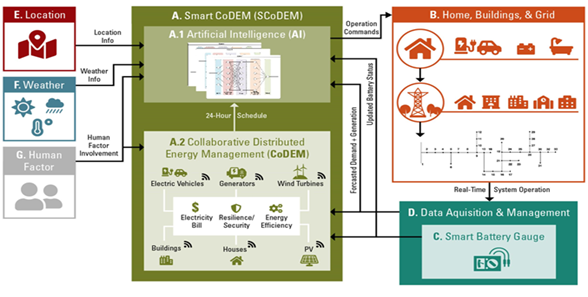
Our research addresses the critical challenge of restoring electricity in the aftermath of disasters, where conventional grid infrastructure is often compromised. We propose an innovative solution that leverages the rapidly growing fleet of Electric Vehicles (EVs) as a decentralized, mobile energy resource. Through Vehicle-to-Grid (V2G) technology, this distributed network of batteries can be coordinated to supply power, significantly enhancing community resilience. The core of our project is an AI-assisted coordination framework, which uses Multi-Agent Reinforcement Learning (MARL) to intelligently manage this system.
In this framework, we model each EV as an autonomous agent that learns optimal charging and discharging strategies through interaction with a simulated post-disaster environment. These agents are trained to pursue a dual-objective goal: to minimize the economic costs while maximizing the amount of power delivered to support disaster-stricken areas. This is achieved by developing a novel reward mechanism that incentivizes agents to charge during low-cost periods and discharge when the grid is most in need, thereby aligning private economic interests with the public good. This decentralized, AI-assisted approach is inherently more robust and scalable than traditional centralized control methods, making it ideally suited for the chaotic and unpredictable conditions of a post-disaster scenario.
The significance of this work lies in its potential to transform disaster response, providing a faster and more adaptive method for power restoration that can save lives and mitigate economic loss. Looking forward, our research will focus on scaling our simulations to model more complex, real-world urban environments, exploring more advanced reinforcement learning algorithms to enhance inter-agent cooperation, and developing hardware-in-the-loop testbeds to validate our findings.
Natural disasters, such as earthquakes, typhoons and floodings, can have a catastrophic impact on the human society. Under such situations, effective and timely power supply is critical for supporting emergency response, medical services, communications, transportation, and other essential services. Microgrid technology can quickly incorporate distributed energy resources to provide local power supply in an islanding mode without reliance on the main grid, making it a promising solution for rapid power restoration after disasters. However, disaster environments are often highly dynamic and complex. The golden 72 hours rescue period and rapidly changing environmental conditions make microgrid energy management a highly time-sensitive task. One of the key challenges is how to properly adapt the objective functions under different operating conditions in this time-sensitive microgrid energy management to achieve timely responses.
To address this challenge, we have been developing an adaptive objective function system for disaster relief microgrids. An objective function library is first established, consisting of various built-in objective functions designed for different disaster relief scenarios. Based on the changing information collected and analyzed from the external environment in the situation awareness, a fuzzy logic system, incorporating human expert knowledge as fuzzy rules, can automatically assign different objective functions with adaptive weight values to represent their relative priorities. Multiple objective functions with the highest priorities are dynamically selected from this library to reflect the most updated disaster site conditions. These selected objective functions are then aggregated linearly into a single-objective optimization form using the determined weights.
We have integrated the objective function library, adaptive weight tuning system, and other energy management functional modules into an EMS research and development fast prototyping platform for disaster relief. This platform enables flexible and convenient configuration of microgrid prototypes for case analysis and proof-of-concept validation in a modular manner. Case studies have demonstrated the effectiveness of the proposed methodology in enhancing the adaptability of the microgrid energy management, making it well-suited for time-sensitive applications such as disaster relief.
Publications:
[1] Z. Long and M.-Y. Chow, “Multi-objective energy scheduling with fuzzy logic-based weight tuning for disaster relief,” in 2025 IEEE International Conference on Industrial Electronics for Sustainable Energy Systems (IESES). IEEE, 2025, (accepted).
[2] Z. Long and M.-Y. Chow, “An ems research and development fast prototyping platform for disaster relief,” 2025, (accepted).
[3] H. Tian, A. Alhaji, Z. Long, and M.-Y. Chow, “Microgrids for post-disaster power restoration application,” in 2024 IEEE 33rd International Symposium on Industrial Electronics (ISIE). IEEE, 2024, pp. 1-6.
Three conference papers from the ADAC lab are accepted and presented at the 2025 IEEE International Conference on Industrial Technology (ICIT 2025) in Wuhan, China.
1. Solid Electrolyte Interface Growth Fault Modeling for Battery State of Health Simulation (Junya Shao, Mo-Yuen Chow) Link
With the extensive application of lithium-ion batteries in energy storage and electric vehicles, safety concerns have become increasingly prominent. Many accidents such as deflagration in battery energy storage stations and fires in electric vehicles have been traced back to performance deterioration and fault generation within the batteries. Therefore, auxiliary fault protection systems for lithium-ion batteries are urgently required to be developed. Incipient fault diagnosis systems, with the benefits of early detection, predictive maintenance, and minimized economic loss, have received increasing attention from battery manufacturers.
To implement effective incipient fault diagnosis and early warning systems for battery protection, it is essential to investigate the underlying degradation mechanisms that govern the evolution of battery health. Among these mechanisms, the formation and growth of the solid electrolyte interface (SEI) on the anode surface play a critical role in the gradual loss of active lithium ions, which directly influences the state of health (SOH) of lithium-ion batteries. Given its importance, an accurate SEI growth model is fundamental to simulating the SOH evolution and enabling incipient fault diagnosis.
To this end, a framework integrating a pseudo-two-dimensional (P2D) electrochemical model with lumped parameter SEI growth mechanisms is developed for battery SOH simulation. The proposed model is validated using the public data from the UCL cycling test on NMC811 batteries. To reflect capacity recovery phenomena observed in experiments, the simulation is divided into five distinct segments, each corresponding to different aging stages with recalibrated initial conditions and parameter sets. The results demonstrate that the infinity norm, the mean absolute error and the root mean square error of SOH simulation are no more than 0.9657%, 0.2227% and 0.3243% respectively. Additionally, the analysis of parameter variation at different aging segments reveals consistent findings aligned with microscopic electrochemical mechanisms. This study confirms that the proposed method provides a reliable and robust framework for SOH simulation and fault evolution analysis in lithium-ion batteries.
2. Modelling of the Solid Electrolyte Interface Growth Using Physics-Based Equivalent Circuit Model (Ziqi Wang, Mo-Yuen Chow)Link
Lithium-ion batteries are critical for modern applications like electric vehicles and renewable energy storage, making accurate battery models essential for ensuring their safety and longevity. A key factor in battery degradation is the growth of the Solid Electrolyte Interface (SEI), a passive layer that forms on the electrode and consumes active lithium, leading to capacity fade. While high-fidelity electrochemical models can describe this process in detail, they are often too computationally intensive for practical, real-time applications, creating a need for simpler yet physically representative alternatives.
This paper presents a physics-based equivalent circuit model (PECM) to simulate the SEI growth in lithium-ion batteries. The study addresses a gap in existing literature by integrating SEI growth dynamics into an equivalent circuit framework, offering a computationally efficient alternative to complex electrochemical models while retaining physical relevance. Key electrochemical parameters are abstracted into circuit elements, allowing the model to capture the impact of SEI thickening on battery performance over time.
The proposed model is validated using experimental battery aging datasets, demonstrating high accuracy in voltage estimation after applying cubic spline interpolation to the open-circuit voltage. Analysis reveals strong correlations between SEI thickness and circuit parameters, showing increased resistance and decreased capacitance as the SEI layer grows. This approach provides a practical tool for predicting battery degradation and supports future development of more comprehensive aging models.
3. Microgrid Communication Network Optimization During Disaster Relief: A Connectivity Rank Index Based Approach (Hengrui Tian, Aditya Joshi, Mo-Yuen Chow) Link
In the aftermath of disasters, the rapid restoration of power is critically needed, particularly for medical facilities. However, both power and communication systems are often severely damaged during such events, making power recovery with limited communication resources a key challenge in disaster relief efforts. This paper proposes a novel strategy for optimizing communication networks within a microgrid energy management system (EMS). The approach utilizes the Connectivity Rank Index (CRI) to evaluate the importance of communication links. The proposed strategy aims to achieve fast energy management response using minimal communication resources during disaster recovery. It iteratively identifies and removes redundant edges from the original network based on CRI. Numerical simulations conducted on a 14-node system demonstrate that the method improves convergence speed by 79.12% and increases communication efficiency by 14.98%, confirming its effectiveness.
Four conference papers from the ADAC lab are accepted by the 51st IEEE Annual Conference of the IEEE Industrial Electronics Society (IECON 2025) in Madrid, Spain.
1. Hierarchical Ensemble Based Clustering For Networked Microgrids (Aditya Joshi, Mo-Yuen Chow)
In last decade, global industrialization along with economic expansion have driven a significant increase in electricity demand worldwide. This surge presents a dual challenge: meeting growing energy needs while maintaining a reliable infrastructure. Over the last decade, the energy industry has experienced significant changes, notably through the growing integration of distributed energy resources (DERs) into the power grid. Networked microgrids have played pivotal role in enabling seamless integration of DERs into the power grid. Conversely, managing such a large-scale cyber-physical system of DERs in a distributed environment presents significant challenges in terms of scalability and convergence time of algorithm. In this context, a Hierarchical Distributed Consensus (HDC) based Energy Management System (EMS) has emerged as a promising solution.
A key prerequisite to ensure an effective implementation of the HDC based EMS is to obtain an optimal hierarchical partition from the network. Manually, evaluating cluster quality for each cluster count requires extensive exploratory effort and is computationally inefficient. Moreover, arbitrarily setting cluster counts becomes impractical for large-scale networks with high node magnitudes, underscoring the need for a sophisticated approach.
This paper proposes a hierarchical ensemble-based method for determining optimal number of clusters in networked microgrid networks. The proposed method incorporates dynamic cluster evaluation and consensus matrix construction based on which elbow method and hierarchical dendrogram are used to determine the optimal cluster formation. The comparative analysis affirms the optimality of the proposed method by examining the influence of cluster configuration on speed of convergence.
2. Impact of Communication Link Failures on Distributed Energy Management in Disaster Relief Microgrids (Hengrui Tian, Aditya Joshi, Mo-Yuen Chow)
Power restoration is a critical priority following disasters, and microgrid-based approaches present a promising solution for enabling rapid and timely resource recovery. However, in distributed microgrid environments, overall system performance heavily depends on the efficiency and reliability of the underlying communication network. Identifying critical communication links can help better coordinate the limited resources available in post-disaster scenarios. The Connectivity Rank Index (CRI) has been established as an effective edge centrality metric for evaluating communication links in distributed energy management systems. This paper introduces a variant called Local-CRI, specifically designed for hierarchical distributed network architectures. Numerical simulations confirm that CRI accurately captures the importance of communication links in relation to consensus performance, outperforming existing methods. Furthermore, Local-CRI effectively quantifies the impact of communication link failures on consensus convergence, particularly within hierarchical distributed networks.
3. Weight Matrix Construction for Distributed Consensus Algorithm in Water-Energy Nexus: Convergence and Robustness (Ahmad ALhaji, Alexandra Duel-Hallen, Mo-Yuen Chow)
Freshwater scarcity continues to pose a significant threat to communities worldwide. With the growing integration of distributed energy resources (DERs), there is an increasing opportunity to couple energy generation with desalination technologies to meet water and energy demands in a unified system. This paper investigates the convergence behavior of distributed consensus algorithms in such coupled water-energy systems, where the interconnection between energy and water processes introduces additional complexity. Specifically, the study examines the impact of different weight-matrix-construction schemes on the convergence speed of the distributed consensus algorithm and its robustness to packet loss. The simulation results show that using the optimal-constant-weight scheme achieves the fastest and most robust convergence but requires global knowledge of the network. However, the maximum-constant-weight scheme, despite requiring global information, has slower convergence speed and is more sensitive to packet loss. In contrast, the local-degree-weight scheme provides comparable performance to the optimal-constant-weight scheme without requiring the system’s global information.
4. Robust Real-Time SOH Estimation via Online Identification of Temperature and SOC Dependent Battery Resistance Model (Skieler Capezza, Mo-Yuen Chow)
Real-time and accurate health estimation of lithium-ion batteries is necessary to ensure the safe and continuous operation of critical systems such as microgrid energy storage systems and modern electric/hybrid vehicles. Estimation of a battery’s state-of-health (SOH) requires online identification of battery model parameters such as internal resistance or battery capacity. Although many papers discuss either the estimation of these parameters in real-time or the identification of these parameter changes at different operating conditions, a unified framework for SOH estimation considering battery states and environmental conditions has not been widely accepted in the field. This paper focuses on the development of a novel methodology for online SOH estimation for lithium-ion batteries utilizing a nonlinear model for electric circuit model (ECM) resistances with dependencies on temperature and state-of-charge (SOC).
The research paper “Multi-Objective Energy Scheduling with Fuzzy Logic-Based Weight Tuning for Disaster Relief” has recently received the Best Paper Award at the IEEE International Conference on Industrial Electronics for Sustainable Energy Systems (IESES) 2025. The master student Mr. Zhiyu Long from the ADAC lab is the first author, and Professor Mo-Yuen Chow is the corresponding author.
Research Overview:
Natural disasters, such as earthquakes, typhoons and floodings, can have a catastrophic impact on the human society. In these situations, effective and timely power supply is critical for supporting emergency response, medical services, communications, transportation, and other essential services during and after disasters. Microgrid technology can quickly incorporate distributed energy resources to provide local power supply in an islanding mode without reliance on the main grid, making it a promising solution for rapid power restoration after disasters. However, disaster environments are often highly dynamic and complex. The golden 72 hours rescue period and rapidly changing environmental conditions make microgrid energy management a highly time-sensitive task. One of the key challenges is how to properly adapt the objective functions under different operating conditions in this time-sensitive microgrid energy management to achieve timely responses.
To address this challenge, the paper presents an adaptive objective function framework for disaster relief microgrids as shown here. Specifically, an objective function library is first established, consisting of various objective functions designed for different disaster relief scenarios. From this library, multiple objectives are selected and combined into a single-objective optimization form through weighted aggregation, with the weight values representing their relative priorities. A fuzzy logic system, incorporating human expert knowledge as fuzzy rules, is then employed to adaptively assign appropriate weights to the selected objectives in response to the changing environmental conditions. Therefore, the priorities of different objectives can be automatically adjusted to reflect the latest disaster site conditions. Case studies have demonstrated the effectiveness of the proposed methodology in enhancing the adaptability of the microgrid energy management, making it well-suited for time-sensitive applications such as disaster relief.
Kelola interaksi pelanggan secara efisien lewat sistem CRM MTP di KAYARAYA, yang dirancang untuk menyatukan data dan strategi dalam satu dasbor cerdas.