Battery Agent

In modern microgrids, battery energy storage systems must respond rapidly to power dispatch commands under complex and uncertain conditions. However, purely tracking power references without considering battery health can accelerate degradation, increase fault risk, and undermine system reliability. As battery systems scale up and become mission-critical, health-aware control is essential.

At ADAC Lab, we develop an intelligent Battery Agent that bridges system-level power coordination and internal electrochemical dynamics. A key research focus is converting external power demands into optimized input currents that satisfy operational requirements while explicitly accounting for battery health and safety constraints.

This capability is built on a physics-informed battery model that captures both electrical behavior and degradation mechanisms. By modeling the negative electrode potential and SEI side-reaction current as internal states, the Battery Agent gains real-time awareness of health dynamics that are invisible to conventional equivalent-circuit-based controllers. This enables informed control decisions that balance performance, safety, and longevity.

Through health-aware optimization and predictive control, the Battery Agent supports intelligent and cooperative energy management in applications such as health-aware dispatch, fault risk reduction, resilient microgrid operation, and scalable agent-based control.

Fuzzy Logic Based Incipient Fault Model

Lithium-ion battery performance and reliability are influenced by incipient degradation mechanisms such as SEI growth, dendrite formation, and particle cracking, which evolve gradually during operation and often precede observable failure. Modeling these early-stage faults is essential for improving battery durability and safety.

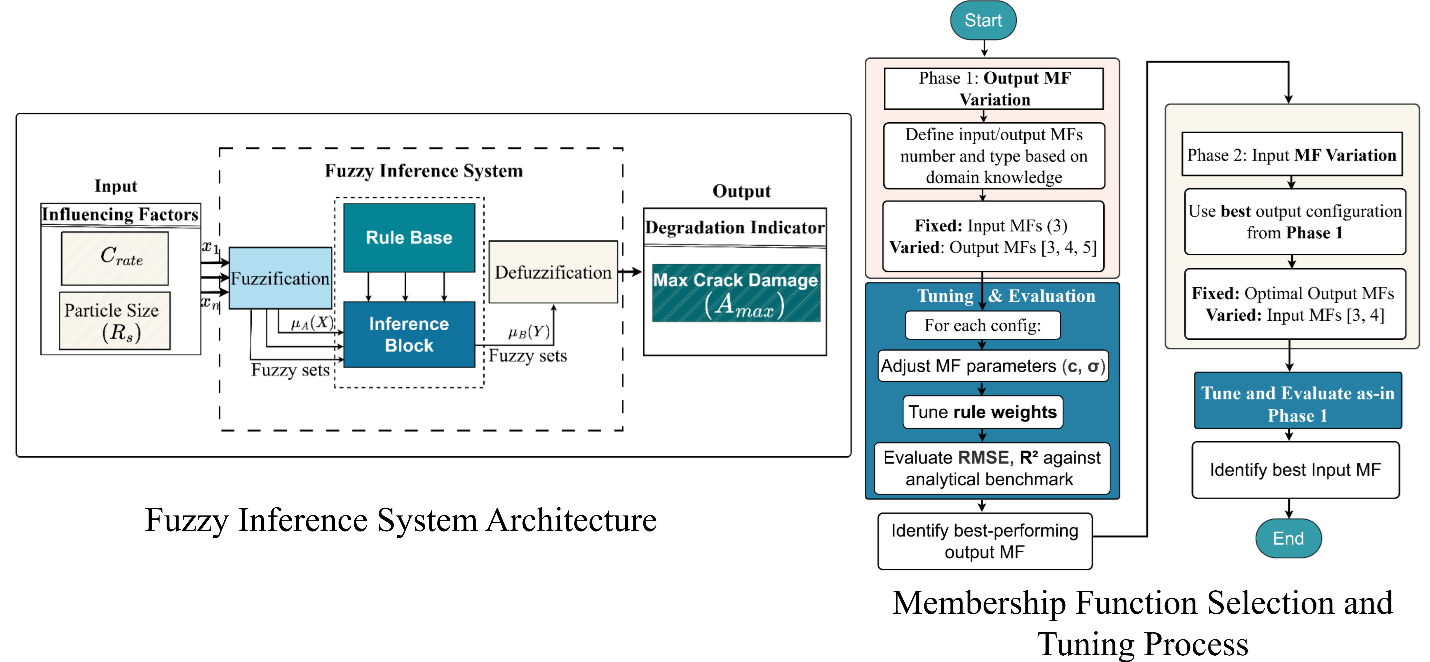
Our research develops fuzzy logic–based methodologies to model battery incipient faults in an interpretable and computationally efficient manner. Compared to data-intensive physics-based models, fuzzy systems translate qualitative degradation knowledge into transparent, rule-based surrogate models.

As a representative study, we model anode particle cracking using a fuzzy inference system, demonstrating a generalizable framework for capturing degradation trends while maintaining analytical transparency.

Microgrid Communication Network Optimization

After disasters, restoring power to critical facilities is urgent, but damage to both power and communication networks complicates recovery. To address this, we applied edge centrality metrics, showing that the Connectivity Rank Index (CRI) effectively measures link importance in distributed structures. We proposed a CRI-based network optimization strategy through pruning and defined a variant, Local-CRI, to assess link failure impact in hierarchical systems.

Future work will integrate edge centrality metrics with power system constraints, providing a quantitative tool to design more efficient and resilient communication networks for microgrids in disaster relief.

Publications:

[1] H. Tian, A. Joshi and M. -Y. Chow, “Impact of Communication Link Failures on Distributed Energy Management in Disaster Relief Microgrids,” IECON 2025 – 51st Annual Conference of the IEEE Industrial Electronics Society, Madrid, Spain, 2025, pp. 1-6.

[2] H. Tian, A. Joshi, M.-Y. Chow, J. Zhou, and G. Chen, “Microgrid communication network optimization during disaster relief: A connectivity rank index based approach,” in 2025 IEEE International Conference on Industrial Technology (ICIT), 2025, pp. 1 – 6.

Intent-Based Energy Management for Smart Grids

The rapid integration of Distributed Energy Resources (DERs) complicates modern grid management, rendering traditional manual operations inefficient. To address this, we propose an Intent-Based Energy Management System that bridges the gap between human goals and machine control.

This approach utilizes two core mechanisms:

  1. Intent Translation: Automatically converting abstract operator goals into executable policies.
  2. Closed-Loop Verification: Ensuring continuous alignment between infrastructure and goals via feedback.

By shielding operators from underlying technical complexities, this paradigm enables intuitive, goal-oriented supervision, ensuring the grid remains resilient and manageable as it scales.

Cyber-Physical Microgrid Restoration via Strategic Link Addition

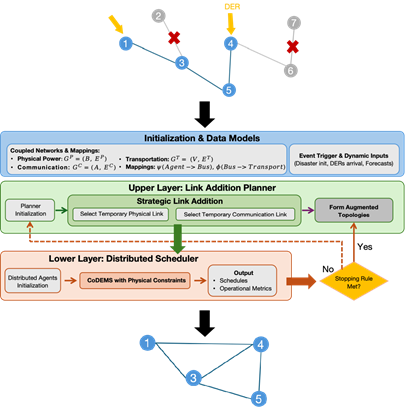
Our research targets rapid power restoration after extreme events when distribution lines are physically damaged and conventional recovery actions fail. We shift from “scheduling on a fixed topology” to adaptive edge augmentation: strategically adding links in both the physical and cyber layers to form an ad-hoc, resilient microgrid.

We propose a two-layer framework. The upper layer (planning) decides which temporary physical power edges (bus-to-bus) and communication edges (agent-to-agent) to add as conditions evolve. The lower layer (scheduling) runs a distributed energy management module to coordinate resources, restore critical loads and maintain stable operation. On the physical layer, robotic or crew-deployed temporary cabling creates electrical connections where permanent infrastructure is unavailable or damaged, enabling restoration across severed segments. On the cyber layer, added communication edges improve algebraic connectivity and speed distributed control convergence.

Ongoing work integrates transportation–energy coupling in complex urban settings, learning-based policies, and hardware-in-the-loop validation.

Adaptive Objective Function

Microgrid has emerged as a promising solution for disaster relief scenarios by enabling the rapid and efficient integration of DERs. However, under highly dynamic and complex disaster environment, microgrid energy management system (EMS) still faces a critical challenge: how to adapt objective functions in response to dynamically changing external conditions to achieve timely and resilient responses.

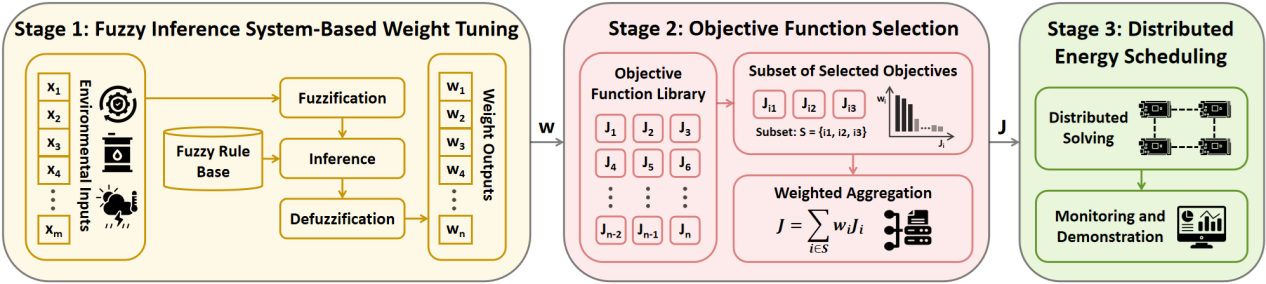
To address this issue, we have developed an adaptive objective function inference and selection (AOFIS) method for disaster relief microgrids. An objective function library is established, composing multiple objective functions designed for diverse disaster scenarios. A fuzzy inference system is then developed to adaptively assign weights to these objectives, reflecting their relative priorities under the prevailing environmental conditions. The highest-priority objective functions can be dynamically selected from the library and aggregated into a weighted single-objective scheduling model together with operating constraint to better fit the current power supply needs and environment. In addition, an EMS research and development (R&D) fast prototyping platform with integrated software libraries and a hardware-in-the-loop (HIL) system is developed to support rapid prototyping, testing, monitoring, and visual demonstration of EMS solutions for disaster applications.

Publications:

[1] Zhiyu Long and Mo-Yuen Chow, “An ems research and development fast prototyping platform for disaster relief,” IEEE/CAA Journal of Automatica Sinica, 2025, (accepted).

[2] Zhiyu Long and Mo-Yuen Chow, “Multi-objective energy scheduling with fuzzy logic-based weight tuning for disaster relief,” in 2025 IEEE International Conference on Industrial Electronics for Sustainable Energy Systems (IESES), 2025, (accepted).

[3] Zhiyu Long and Mo-Yuen Chow, “Objective function library and adaptive objective selection for resilient microgrids in disaster relief,” in 2026 27th IEEE International Conference on Industrial Technology (ICIT), 2026, (submitted).

[4] Zhiyu Long and Mo-Yuen Chow, “Adaptive Objective Function Inference and Selection-Based Distributed Energy Scheduling (AOFIS-DES) in Disaster Relief Microgrids,” IEEE Transactions on Industrial Informatics, 2026, (submitted).