
by chow | Mar 18, 2012 | Completed projects
Project Description:
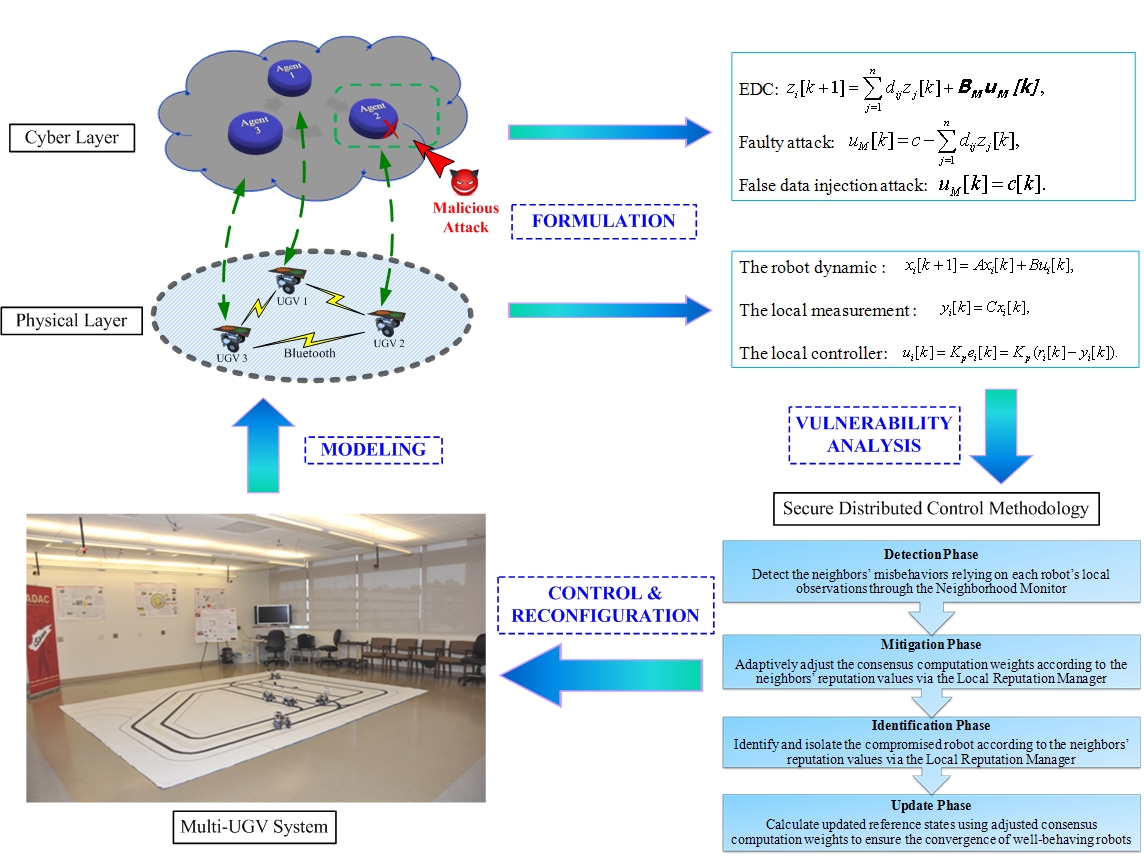
While most Networked Control systems (NCS) have been safe in the past, they are increasingly more vulnerable to malicious cyber attacks and malwares (e.g. Stuxnet and Flame) with the rapid advancements and uses with networking, embedded systems, wireless communication technologies, and novel control strategies. In particular, more and more distributed control algorithms are being used in NCS because of their flexibility, robustness, computation, and communication features. These algorithms, however, increase the vulnerability of NCS to malicious cyber attacks. Thus, there is an urgent growing concern to protect control algorithms from malicious cyber attacks.
In this project, we have considered the fundamental task of reaching an agreement (i.e., consensus) among a group of agents via secure distributed computations in NCS. We have explored the vulnerabilities of a variety of distributed control algorithms and designed secure distributed control methodologies that are capable of performing secure consensus computation in the presence of misbehaving agents in NCS. We will further examine the proposed algorithms in three different scenarios: one misbehaving agent, multiple non-colluding misbehaving agents, and multiple colluding misbehaving agents. Our ultimate goal is to develop secure distributed control and management algorithms and analytic frameworks for NCS. Also, in order to analyze the performance of our theoretical design on a real-world problem, we will examine and evaluate the proposed techniques in intelligent transportation systems and Smart Grid operations.
Publications
- W. Zeng and M.-Y. Chow, “Resilient Distributed Control in the Presence of Misbehaving Agents in Networked Control Systems,” IEEE Transactions on Cybernetics, vol. 44, pp. 2038-2049, 2014.
- W. Zeng and M.-Y. Chow, “A Reputation-Based Secure Distributed Control Methodology in D-NCS,” IEEE Transactions on Industrial Electronics, vol. 61, pp. 6294-6303, 2014.
- W. Zeng and M.-Y. Chow, “Convergence and recovery analysis of the secure distributed control methodology for D-NCS,” in 2013 IEEE International Symposium on Industrial Electronics (ISIE), 2013, pp. 1-6.
- W. Zeng, M.-Y. Chow, and P. Ning, “Secure distributed control in unreliable D-NCS,” in 2012 IEEE International Symposium on Industrial Electronics (ISIE), 2012, pp. 1858-1863.
Links
by chow | Sep 27, 2011 | Completed projects
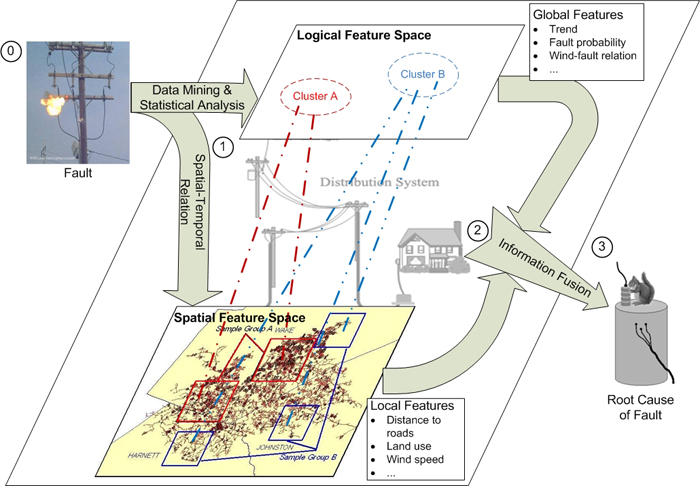
Small world stratification with causality aggregates both local spatial features (e.g., circuit connections, land use) and global logical features (e.g., strong wind is more likely to cause tree faults) from distributed information for effective and efficient power distribution fault diagnosis.
Power distribution systems are large-scale, nonlinear, time-varying, and geographically dispersed with a wide range of dynamic operating conditions with both global and local features. It is important to correctly diagnose system faults with proper causality and restore the systems in a timely manner to maintain their vitality. The concept of small world comes from the experiments on social networks – on average, two strangers can reach each other through six mutual friends. A small-world network can be modeled as a mathematical graph in which most nodes are not neighbors of one another, but can be reached from every other by a small number of hops. Small world with causality (SWC) adds the cause-and-effect in the small world network. This project uses the SWC concept to perform fault diagnosis in power distribution systems. Rather collecting and processing all data in a central location, SWC will properly search relevant data for decision making in a distributed manner. Highlights of this small-world with causality project include:
- Extract
- Global logical features through data mining and statistical analyses on Progress Energy and Duke Energy power distribution outage data,
- Local spatial features from GIS data (e.g., land-usage maps, vegetation maps), on-line weather maps, and power distribution circuits
- Develop an optimal causal structure to integrate the aforementioned information (data mining, GIS, etc.) for power distribution fault diagnosis.
We are also developing a spatial-time power distribution system fault simulator to provide a test-bed and research tool for this research project.
Documentations
Links
by chow | Sep 27, 2010 | Internships
About the Project
This project aims at developing a Graphic Display Interface for the AIS based Intelligent Transportation System, which can run the Simulink module and display the result of the simulation graphically.
Documentations
by chow | Sep 27, 2010 | Internships
About the Project
The project aims to emulate common traffic scenarios on the road scenario using four Lego Mindstorms Robots.The algorithms implemented states of the robot,simulated in the simulink already, defining the robot behaviors.Each robots is assigned a specific priority to avoid traffic accidents.
Documentations
by chow | Sep 27, 2010 | Internships
About the Project
This project aims at building online instruments that can transmit sampled voltage, load current and temperature of a PHEV Li-ion battery to laptop via ZigBee wireless network, and to Manicipal Parking Lot Charging Station via Internet.
Documentations
by chow | Sep 27, 2010 | Completed projects
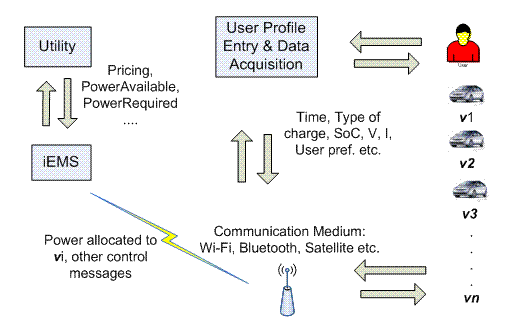
There is a need to address potential problems due to the emergence of technologies that will affect the utility industry in a time horizon of less than 20 years. One such technology is the plug-in hybrid electric vehicle (PHEV); the emergence of these vehicles in the marketplace poses a potential threat to the existing power grid. With a large number of these vehicles ‘plugged-in’ for charging, in the absence of control over the power drawn, the additional load can result in grid instabilities and disruptions. As a solution to alleviate such a situation and to allow for smooth integration of PHEVs into the grid, an “intelligent energy management system” (iEMS) is proposed in this project. The iEMS intelligently allocates power to the vehicle battery chargers through real time monitoring and control, to ensure optimal usage of available power, charging time and grid stability. This project is in collaboration with the FREEDM Systems Center and the Advanced Transporation Energy Center, NCSU, Raleigh.
Theoretical Focus:
The research work in this project aims to provide the conceptualization of the system architecture and the definition of its components, their attributes and interactions for enabling PHEV integration. The theoretical system description is implemented on a simulation test-bed for simulating myriad real world scenarios. Work is also ongoing to provide a mathematical framework for developing the iEMS algorithm for the optimal power allocation strategy under utility power constraints; taking into consideration the vehicle battery parameters and user preferences.
Demonstration Focus:
The system performance will be validated in a real world deployment with the implementation of the iEMS algorithm using actual vehicle batteries and in the presence of an enabling communication network. As a beginning step towards this, an experimental setup consisting of a Labview based GUI (with iEMS code) has been developed. The GUI monitors simulated batteries in ZigBee communication nodes and controls the charging process via wireless communication.
Documentations
Links